
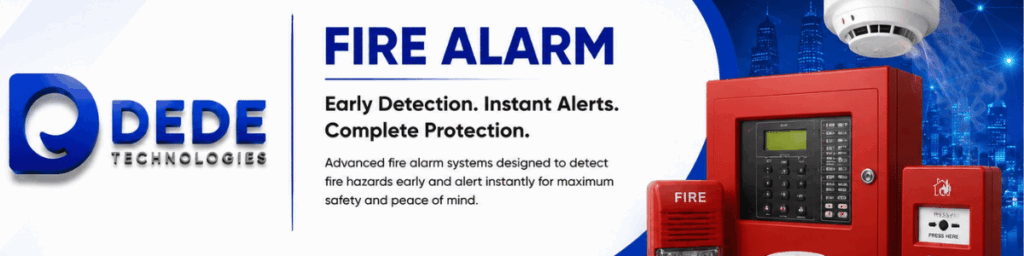
Fire Alarm System
Detect Early. Alert Faster. Protect Lives & Property.
Looking for a reliable Fire Alarm Systems in Chennai? DEDE Technologies provides fire detection and alarm solutions for offices, apartments, factories, warehouses, schools, colleges, hospitals, hotels, retail stores, and commercial buildings.
A properly designed fire alarm system helps detect signs of fire at an early stage and alerts occupants so they can respond quickly and evacuate safely. From basic conventional systems to advanced addressable fire alarm solutions, we provide site assessment, system design, installation, testing, maintenance, and technical support.
Call: +91 95001 26219
What is a Fire Alarm System?
A Fire Alarm System is an electronic life-safety system designed to detect smoke, heat, or other indications of fire and provide an audible or visual warning.
A typical system works through:
Smoke / Heat Detection → Fire Alarm Control Panel → Alarm Activation → Occupant Notification → Emergency Response
Depending on the system design, fire alarms can include automatic detectors, manual call points, hooters, sounders, strobes, control modules, and monitoring interfaces.
Early detection is critical because every second matters during a fire emergency.
Why Install a Fire Alarm System?
Fire can spread rapidly and cause serious risks to people, property, equipment, inventory, and business operations.
Therefore, an appropriately designed and maintained fire alarm system forms an important part of a building’s overall fire-safety strategy.
Key Benefits
- Early Fire Detection
- Smoke & Heat Detection
- Fast Occupant Warning
- Manual Emergency Activation
- Audible & Visual Alerts
- Zone-Based Fire Identification
- 24/7 System Monitoring
- Faster Emergency Response
- Improved Life Safety
- Reduced Risk to Property
- Integration with Compatible Safety Systems
- Event & Fault Monitoring
Our Fire Alarm Solutions
Conventional Fire Alarm System
A Conventional Fire Alarm System divides a building into different detection zones.
When a detector or manual call point activates, the control panel identifies the affected zone, helping security or emergency personnel locate the general area of the incident.
Conventional systems can be suitable for:
- Small Offices
- Shops
- Schools
- Clinics
- Small Warehouses
- Commercial Properties
Addressable Fire Alarm System
An Addressable Fire Alarm System identifies individual field devices through unique addresses.
Therefore, when an alarm occurs, the control panel can provide more precise information about which detector or device has activated.
Addressable systems are particularly suitable for:
- Large Commercial Buildings
- Hospitals
- Hotels
- Educational Campuses
- Factories
- Warehouses
- Corporate Offices
- Multi-Storey Buildings
They also provide improved system monitoring and fault identification compared with simpler zonal systems.
Fire Alarm System Components
A complete fire alarm installation may include:
Fire Alarm Control Panel
The central unit that receives signals from field devices and manages alarms, faults, and system status.
Smoke Detectors
Detect smoke particles associated with developing fires. Detector selection and placement should match the application and applicable requirements.
Heat Detectors
Respond to temperature conditions and may be used in suitable environments where smoke detection is not appropriate.
Manual Call Points
Allow occupants to manually activate the fire alarm when they identify a fire or emergency.
Hooters / Sounders
Provide audible warnings so occupants know that emergency action may be required.
Visual Alarm Devices
Strobes or visual indicators can complement audible notification where required.
Modules & Interfaces
Compatible modules can connect the fire alarm system with other building or safety systems according to the approved design.
Power Supply & Battery Backup
Backup batteries help the system remain operational during interruptions to normal electrical power, subject to system design and maintenance.
Fire Alarm Systems for Offices & Commercial Buildings
Commercial buildings contain employees, visitors, electrical equipment, furniture, documents, and other assets.
Fire alarm systems can monitor areas such as:
- Office Floors
- Reception Areas
- Electrical Rooms
- Server Rooms
- Storage Areas
- Corridors
- Common Areas
- Parking Facilities
The system should form part of a wider fire-safety and evacuation plan.
Fire Alarm Systems for Factories & Warehouses
Protect People, Inventory & Operations
Industrial environments may involve machinery, electrical equipment, raw materials, storage racks, production processes, and other potential hazards.
A professionally designed system can provide detection and notification across:
- Production Areas
- Warehouses
- Electrical Rooms
- Administrative Blocks
- Storage Areas
- Utility Rooms
- Loading Areas
- Other Identified Risk Zones
System design should account for the environment, occupancy, hazard profile, applicable codes, and fire-safety requirements.
Fire Alarm Systems for Schools & Colleges
Educational institutions need reliable warning systems to support safe evacuation during emergencies.
Fire alarm coverage may include:
- Classrooms
- Laboratories
- Libraries
- Auditoriums
- Administrative Offices
- Corridors
- Common Areas
- Hostels
- Electrical Rooms
Regular evacuation drills and staff awareness should complement the installed fire alarm system.
Fire Alarm Systems for Hospitals
Healthcare environments require particularly careful fire-safety planning because patients may have limited mobility and certain areas contain specialized equipment.
Hospitals may require detection across:
- Patient Areas
- Laboratories
- Pharmacies
- Administrative Areas
- Electrical Rooms
- Storage Areas
- Corridors
- Other Critical Zones
The final design should follow applicable fire-safety regulations and the requirements of the relevant authorities and consultants.
How to Choose the Right Fire Alarm System
Fire alarm selection should never depend only on price.
Several factors must be evaluated.
Building Size & Layout
Larger and more complex buildings may require addressable systems and more detailed monitoring.
Occupancy
A school, hospital, warehouse, office, and factory each has different life-safety considerations.
Fire Risk
The activities, materials, electrical infrastructure, and environmental conditions influence detector selection.
Detection Requirements
Smoke, heat, or other detection technologies should be selected according to the environment and approved system design.
Alarm & Notification Requirements
Audible and visual notification should provide appropriate coverage for building occupants.
Future Expansion
Systems for growing facilities should provide suitable capacity for future requirements.
Compliance
Most importantly, system design and installation should comply with applicable fire-safety codes, approved plans, local authority requirements, and relevant Indian standards.
Fire Alarm Integration
Depending on the approved system architecture and compatible equipment, fire alarm systems may interface with other building systems.
These can include:
- Access Control
- Building Management Systems
- Public Address Systems
- Fire Suppression Interfaces
- Selected HVAC Controls
- Elevator / Lift Interfaces
- Emergency Door Release
- Central Monitoring Systems
Because fire alarms are life-safety systems, integrations should be professionally designed, tested, documented, and maintained.
Fire Alarm Maintenance & Best Practices
Installing a fire alarm system is only the beginning. Regular inspection and maintenance are essential.
Recommended practices include:
- Inspect the Fire Alarm Control Panel
- Test Detectors as Required
- Test Manual Call Points
- Verify Hooters & Notification Devices
- Check Battery Condition
- Monitor Fault Indicators
- Keep Devices Free from Obstruction
- Maintain System Records
- Replace Defective Components Promptly
- Conduct Periodic Fire Drills
- Follow Applicable Inspection & Testing Requirements
- Use Qualified Personnel for Maintenance
Organizations should maintain appropriate service records and follow the maintenance intervals required by applicable standards and authorities.
Why Choose DEDE Technologies?
DEDE Technologies provides fire alarm solutions with an emphasis on proper assessment, appropriate product selection, professional installation, testing, and long-term support.
Our Fire Alarm Services
- Site Assessment
- Requirement Analysis
- System Planning
- Conventional Fire Alarm Systems
- Addressable Fire Alarm Systems
- Smoke & Heat Detection
- Manual Call Points
- Hooters & Notification Devices
- Installation & Cabling
- System Configuration
- Testing & Commissioning
- Existing System Upgrades
- Preventive Maintenance
- AMC Support
- Technical Assistance
For statutory or complex projects, the final solution should align with approved fire-safety designs and requirements from relevant authorities and consultants.
Fire Alarm System Installation in Chennai
DEDE Technologies provides Fire Alarm Systems in Chennai for residential, commercial, institutional, and industrial applications.
Our service areas include Ambattur, Anna Nagar, Mogappair, Padi, Porur, T. Nagar, Nungambakkam, Guindy, Adyar, Velachery, Perungudi, Thoraipakkam, Sholinganallur, Pallikaranai, Tambaram, Madhavaram, Ambattur Industrial Estate, Guindy Industrial Estate, SIDCO Industrial Estate, Sriperumbudur, Oragadam and surrounding areas.
Frequently Asked Questions
Which fire alarm system is best for my building?
The right solution depends on building size, occupancy, layout, risk profile, applicable codes, and authority requirements. A professional assessment should be completed before system selection.
What is the difference between conventional and addressable fire alarms?
Conventional systems generally identify the affected zone. Addressable systems can identify individual devices, providing more precise alarm and fault information.
Do fire alarm systems work during a power failure?
Properly designed fire alarm systems include standby power arrangements such as batteries. Backup capacity should meet the requirements applicable to the installation.
How often should a fire alarm system be serviced?
Inspection and testing frequencies depend on the system, applicable standards, manufacturer recommendations, and local regulatory requirements. Scheduled preventive maintenance is essential.
Can fire alarms integrate with access control?
Compatible systems can be designed to interface with access control and other building systems for specific emergency functions. Such integrations should follow the approved fire-safety design.
Protect Lives Before Property
Fire safety begins with early detection, clear warning, proper evacuation planning, and regular maintenance.
Whether you require a fire alarm solution for an office, school, hospital, hotel, apartment, warehouse, factory, or commercial building, DEDE Technologies can help you plan and implement an appropriate system.
Request a Fire Alarm Site Assessment
✓ Conventional & Addressable Systems
✓ Professional System Planning
✓ Installation & Testing
✓ Preventive Maintenance
✓ AMC & Technical Support
Call: +91 95001 26219
Website: www.dedetechnologies.com
DEDE Technologies – Early Detection. Faster Warning. Safer Spaces.